
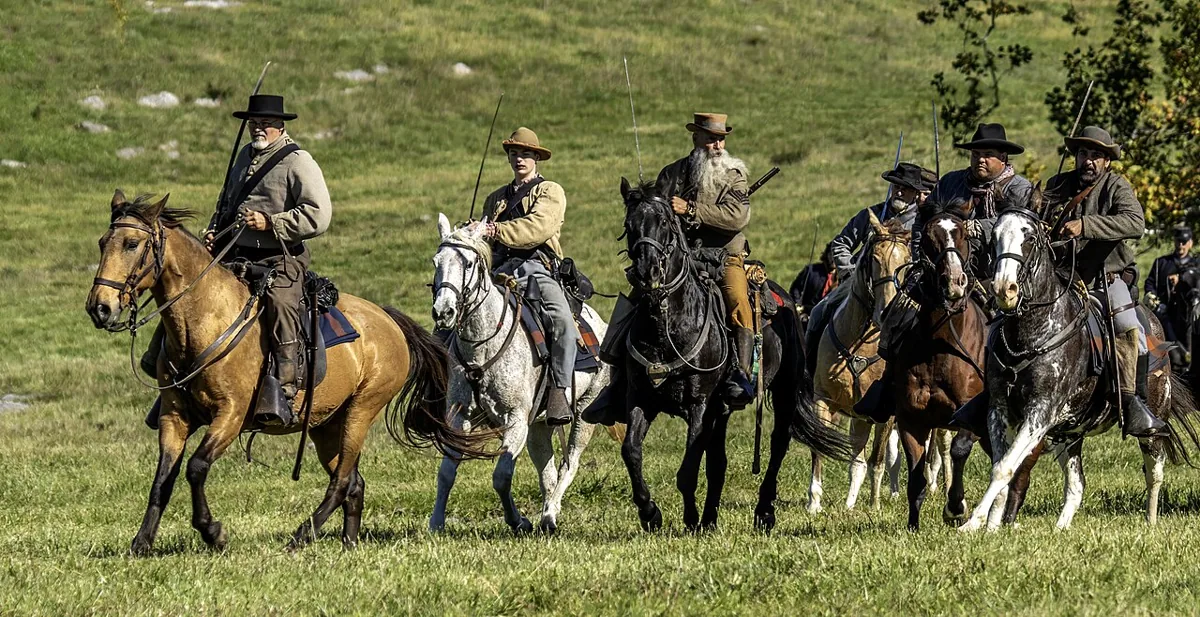
There is something peculiar about walking into a place that belongs to another century, especially when you know perfectly well that it does not.
You pass through a gate and find timber-framed buildings, merchants calling from their stalls, musicians playing instruments unfamiliar to most modern ears, perhaps a blacksmith at a forge. Someone in armour walks past a woman in elaborate Renaissance dress. A few metres away, another visitor is eating something that would probably mystify an actual sixteenth-century cook.
You know it is a Renaissance fair. You know that the people around you probably arrived by car, that the buildings may conceal electrical wiring, and that some costumes belong to periods separated by centuries. The spell does not require you to forget any of this.
For an afternoon, you are somewhere else.
This attraction extends well beyond Renaissance fairs. In Japan, visitors walk through reconstructed Yayoi settlements or streets built for period films. In France, craftspeople are constructing a medieval castle using methods available to their predecessors. In Manila, people wander through the surviving and reconstructed streets of Intramuros, a city whose history remains embedded in its walls even where much of the old city has disappeared.
These places differ considerably in purpose, accuracy, and historical significance. Yet each offers the possibility of encountering another age as a physical environment rather than simply a subject to be studied. Why do we find that so compelling?
An old world invented in modern California
The modern American Renaissance fair has an unexpectedly recent history. In 1963, Phyllis and Ron Patterson helped establish the Renaissance Pleasure Faire and May Market in California. Drawing on educational theatre, performance, craft, and community participation, the event constructed an environment inspired by Elizabethan England. Its origins also belonged to a particular moment in twentieth-century American cultural life. Performers, artisans, and volunteers assembled stages, market stalls, costumes, and a world that visitors could temporarily inhabit. [1]
There is an agreeable irony here: a modern tradition associated with premodern Europe took shape amid California's own artistic and countercultural experiments. But people have long used earlier ages to think about the present. Medieval writers imagined classical antiquity. Renaissance scholars sought to recover Greek and Roman learning. Nineteenth-century Europeans recreated the Middle Ages in literature, art, and architecture. A modern Renaissance fair continues that habit, though often with more humour and less solemnity.
Nor does participation necessarily imply confusion about history. Some visitors and performers care deeply about historical clothing, craft, music, weaponry, or fencing. Others are interested in theatre, fantasy, social life, or the pleasure of making and wearing a costume. Someone in historically implausible armour may understand armour quite well. The costume is not always a claim about the past. Sometimes it is an invitation to play, and that play can become the beginning of serious curiosity.
Looking at the past, and entering it
Most encounters with history come through objects and explanations: a book, a painting, a manuscript, a museum case. These can be intellectually rich, but a reconstructed environment changes what we notice. A narrow street constrains movement. A raised watchtower makes its position intelligible. The incline of a path, the width of a doorway, or the arrangement of buildings can convey something a plan on a page does not easily communicate.
At Yoshinogari Historical Park in Saga Prefecture, Japan, archaeological remains of a Yayoi-period settlement are preserved alongside reconstructed buildings and defensive structures. The reconstructions are informed by excavation, comparison, and interpretation rather than a complete surviving blueprint. The questions are immediately practical: how might the roofs have been supported, what were the functions of different buildings, and why were structures arranged as they were? [2, 3]
A visitor cannot thereby become a Yayoi inhabitant. Yet a physical model of an earlier settlement allows us to test our intuitions about space and scale. It is a different kind of historical encounter. The reconstruction is also a reminder of uncertainty: archaeology supplies evidence, but rarely every feature needed to build a house again.
Other Japanese sites, including Sannai-Maruyama in Aomori, offer opportunities to encounter reconstructed prehistoric dwellings while seeing the archaeological record from which interpretations arise. These sites can later receive their own place essays. For now, Yoshinogari is enough to make the distinction clear. A recreated settlement may be an instrument of historical inquiry, not simply scenery. [4]
Building a medieval castle, and testing the work

At Guédelon in Burgundy, France, the historical environment is not a completed replica. Craftspeople are constructing a castle through an experimental project informed by thirteenth-century techniques, materials, and building knowledge. Quarrying, dressing and lifting stone, working timber, and making the necessary tools all become part of the historical question. [5]
A finished wall tells us something about a building. Constructing one makes labour and sequence unavoidable. Someone must extract the stone, transport it, shape it, and raise it. Timber has to be selected and worked. Tools wear out. The next phase depends on the previous one. Historical documents and surviving structures supply the evidence, while the work tests what proposed methods demand of real materials and real people.
Such experiments cannot prove that medieval craftspeople performed every step identically. Different procedures can lead to similar results, and modern practitioners bring their own skills. But attempting the work can expose assumptions that are easy to overlook when history is reduced to finished monuments.
Here the experience of the past is also the experience of its difficulty. The castle was not originally designed to look picturesque to tourists. It was a functioning construction project, with costs, materials, people, and problems to solve.
The past in the body
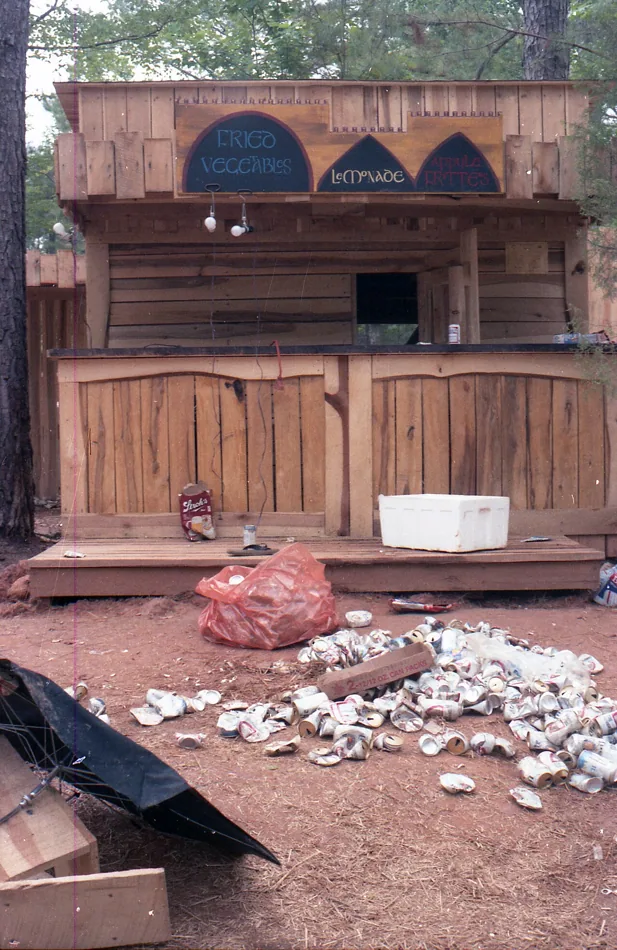
Buildings are not the only way to investigate earlier practices. Some historical questions demand movement.
Practitioners of Historical European Martial Arts (HEMA) examine surviving fencing manuals and fight books, attempting to understand older systems of swordsmanship, wrestling, and armed combat through interpretation and controlled practice. Reading a description of a technique is one thing. Testing distance, balance, timing, and what happens when another person resists is another. The activity can be both historical investigation and a contemporary competitive discipline.
Buhurt, or modern full-contact armoured combat, takes a different direction. Competitors wearing historical-style armour fight with regulated, blunted weapons, sometimes in team melees. M-1 Medieval, associated with the M-1 mixed-martial-arts promotion, offered a more explicitly spectator-oriented, one-on-one version of armoured fighting. Neither should be mistaken for an exact recreation of medieval warfare. They are modern sports and spectacles inspired by aspects of historical combat. Yet the physical effort required to move, grapple, and fight in armour makes one thing quickly apparent: equipment that looks impressive in a museum also has weight, limitations, and a relationship to the body using it.
Other traditions illustrate a different relationship with history. Japanese kobudō, including Okinawan weapons systems, Malay-Indonesian pencak silat, Filipino arnis or eskrima, and Indian kalaripayattu have histories of instruction, adaptation, and cultural transmission. They are living martial practices, not museum tableaux and not necessarily unchanged survivals of some distant origin. Their historical trajectories differ from reconstruction based chiefly on European fight books. What unites these examples is the way history may be approached through practiced skill, and the need to distinguish what evidence actually establishes from what romantic accounts claim.
These forms of combat and martial practice deserve essays of their own. Here they remind us that an earlier world was populated by moving bodies, not merely buildings.
A Japan built for the camera
Not every historical environment aims at archaeological reconstruction. At Toei's Eigamura in Kyoto, streets and buildings evoke the worlds familiar from Japanese period films and television dramas. The environment belongs as much to cinema as to historical architecture. Production needs influence what is built: places must look convincing through a camera and accommodate performers, crews, and changing scenes. [6]
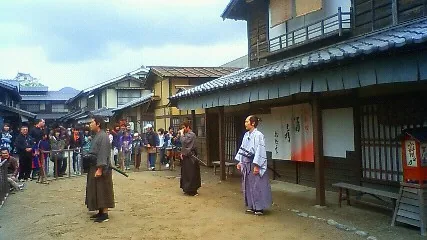
Visitors who know jidaigeki films and television may find the experience particularly affecting. They are not necessarily recognizing an authentic street from Edo-period Kyoto. They are recognizing a visual language made familiar through years of storytelling.
Usually a film permits us to imagine entering its world. Here we can walk around something like that world, turn its corners, approach its gates, and look into its shopfronts. The fiction has acquired dimensions and weight. That does not make it documentary evidence about the Edo period. It makes its appeal easier to understand.
A Dutch town in Nagasaki
Huis Ten Bosch, opened in 1992 in Sasebo, presents a Dutch-inspired landscape of canals, European-style buildings, gardens, and squares. It is a themed resort, not an archaeological reconstruction of a Dutch settlement that once occupied that site. [7]
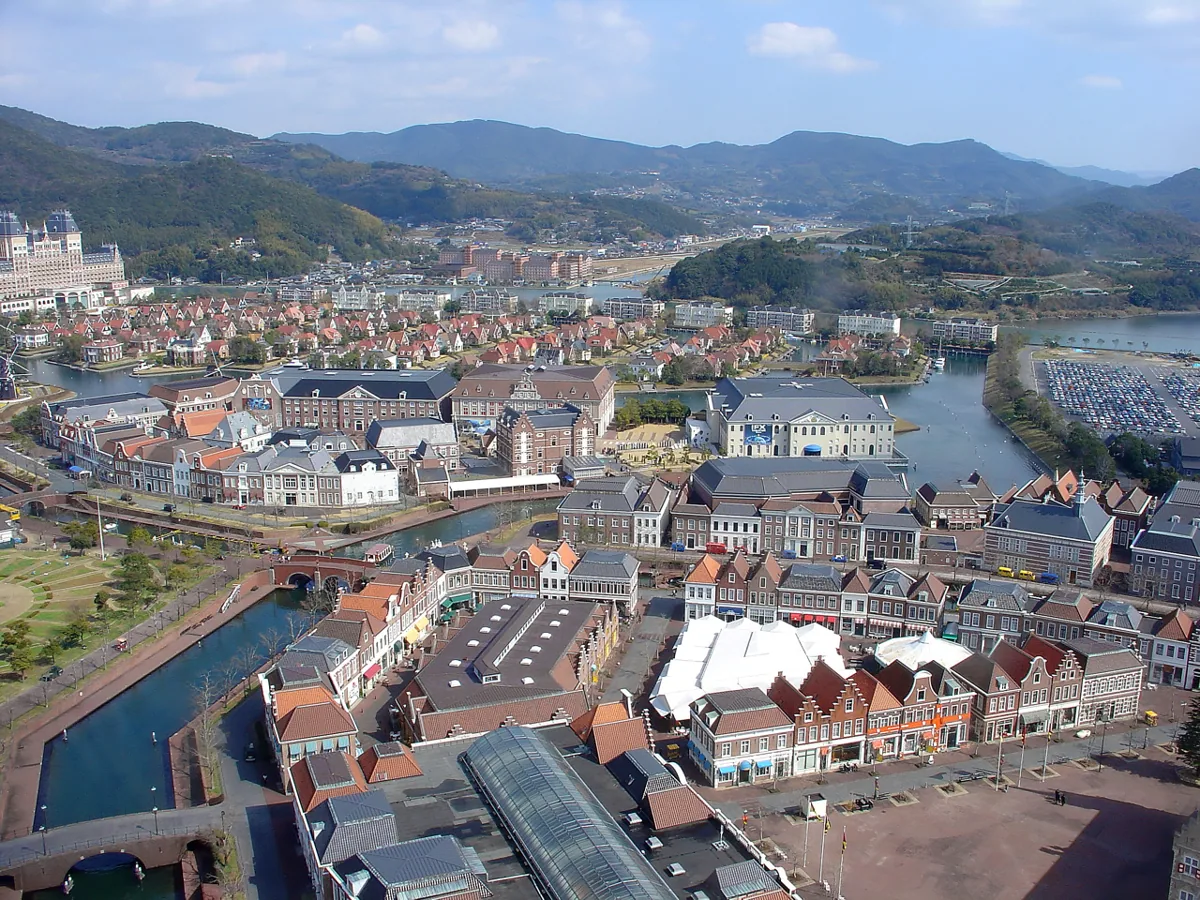
Yet the setting has an intriguing regional history. The Dutch East India Company established a trading post in Hirado in 1609, including substantial commercial buildings. In 1641 the Dutch trading establishment moved to Dejima in Nagasaki, where merchants lived and worked under the restrictions of the Tokugawa shogunate. Today, Hirado's trading-post warehouse has been reconstructed, while Dejima preserves and interprets its historic setting through restored and reconstructed buildings. [8, 9]
The contrast is worth keeping. The Dutch merchants of seventeenth-century Nagasaki did not inhabit the grand townscape recreated at Huis Ten Bosch. Nevertheless, the Dutch association with the region is genuine. In one prefecture, a visitor can move between places interpreting an actual history of trade and a modern landscape inspired by an idealized Netherlands.
An imagined environment can grow from a historical connection without reproducing that history literally. Recognizing the distinction makes both kinds of place more interesting.
When the city was really there
Other places present neither a wholly reconstructed settlement nor a deliberately theatrical one, but a landscape assembled from survival, destruction, and repair.
Intramuros, the walled city of Manila, developed as the fortified centre of Spanish colonial Manila. It contained churches, residences, schools, government buildings, and defensive works: a functioning city in which people lived, worked, worshipped, exercised authority, and died. The destruction of Manila in 1945 devastated much of it. What visitors encounter today combines surviving fabric, ruins, restorations, and later reconstructions. [10, 11]
Intramuros is not historical scenery detached from everyday life. It remains part of a busy modern city. This changes the questions one might ask. Which period is being presented in a restoration? What survives beneath the visible reconstruction? What does a public memory of colonial Manila emphasize, and what does it leave harder to see? These are historical and civic questions, not merely questions of attractive architecture.
Jinjuseong, the fortress at Jinju in southern Korea, offers another instructive example. Overlooking the Namgang River, it was the site of major fighting during the Japanese invasions of Korea in the 1590s. Its structures and commemorative landscape bear the marks of warfare, later destruction, and rebuilding. The Chokseongnu pavilion visible today was reconstructed after its destruction during the Korean War. As at Intramuros, one encounters a place whose significance survives even though its present appearance is the result of several historical periods. [12]
A surviving historical site can be more affecting than a carefully made replica, partly because the physical place has continued to participate in events. But it is not necessarily a transparent window into one past moment. Every restoration is also a decision made in the present.
What are we looking for?
The obvious explanation for all these experiences is nostalgia. People imagine simpler or more beautiful times, conveniently leaving out disease, inequality, war, and the ordinary hardships of historical life. Romanticization certainly exists. A Renaissance fair generally offers a more agreeable day than life under the actual political and social conditions of early modern Europe.
Yet nostalgia alone is inadequate. One visitor wants to understand how a Yayoi settlement was organized. Another is interested in how medieval masons lifted heavy blocks. Someone else enjoys costume-making, live performance, or shared enthusiasm. An admirer of samurai cinema may want to walk through the kind of setting seen on screen. These motivations can coexist, and none requires the belief that the past was universally better.
There is also the pleasure of discovering how something worked. A castle entrance may appear picturesque in a photograph, but a constrained approach can reveal its defensive logic when experienced on foot. A reconstructed village might seem quaint until its arrangement suggests problems of storage, watchfulness, shelter, or collective labour. Historical structures were not originally constructed to be admired by future visitors. They were made to do things.
That realization changes how we look at them. Earlier people become less like costumed figures in a picture and more like people working within the practical circumstances of their own age.
Remembering what we never knew
Sometimes a historical environment seems strangely familiar despite our certainty that we have never visited it. Much of that familiarity may come from stories, films, books, museums, games, and pictures encountered over many years. When elements of those learned worlds appear before us at full scale, recognition can be vivid even if its sources are hard to identify.
This loosely connects the present essay to Mara C.'s Places We Have Never Been, which considers nostalgia for fictional environments through Life Is Strange, and to delMar's Déjà Vu and the Problem of Familiarity. The experiences are not neurologically identical. A learned association with a fictional landscape is not, by itself, déjà vu. But all three essays ask, in different ways, why something we have never lived through can seem curiously close to memory.
Reconstructed places give these impressions a physical form. We can stand in a street, hear tools strike stone, feel the rise of a path, or look across a defensive wall. None of this turns an imagined past into our own lived history. It creates a new experience now, shaped by what we know, what we think we know, and what we are beginning to understand.
We cannot actually visit medieval Burgundy, Yayoi Japan, Edo-period Kyoto, or colonial Manila as their inhabitants experienced them. Too much has changed; too much of ordinary life is gone. But we can encounter evidence of those worlds, reconstruct parts of their material circumstances, and occasionally understand an old practical problem much better by seeing it at human scale.
We may also enjoy fantasy, theatrical illusion, costume, and play. There is no need to apologize for that. A Renaissance fair is not an excavation, a film set is not a surviving town, and a reconstructed castle is not a castle built in the thirteenth century. Each can still be worthwhile on its own terms.
We go knowing we cannot visit the past. Knowing this has never entirely discouraged us from trying.
The distant-world counterpart appears in The Great Moon Hoax of 1835, where supposed scientific reports briefly furnished the Moon with landscapes and inhabitants. Readers could imagine the place in considerable detail, although the claims were contested from the outset.
References and research starting points
- Smithsonian Magazine. “The Surprisingly Radical Roots of the Renaissance Fair” (2023). https://www.smithsonianmag.com/history/the-surprisingly-radical-roots-of-the-renaissance-fair-180982918/
- Yoshinogari Historical Park, official site. https://www.yoshinogari.jp/en/
- Yoshinogari Historical Park, archaeological research and reconstruction. https://www.yoshinogari.jp/en/introduction/excavation/
- Sannai-Maruyama Site, official English site. https://sannaimaruyama.pref.aomori.jp/english/
- Guédelon, official project site. https://www.guedelon.fr/en/
- Toei Kyoto Studio Park / Eigamura, official site. https://en.eigamura.com/
- Huis Ten Bosch, official site. https://english.huistenbosch.co.jp/
- Nagasaki tourism, Hirado Dutch Trading Post. https://www.discover-nagasaki.com/en/
- Dejima, official historic site. https://nagasakidejima.jp/english/
- Intramuros Administration, official site. https://intramuros.gov.ph/
- Intramuros Administration, Fort Santiago site information. https://intramuros.gov.ph/fs/
- Jinju City / Korean heritage and tourism sources on Jinjuseong Fortress and Chokseongnu. Specific primary source URL to be confirmed before publication.