
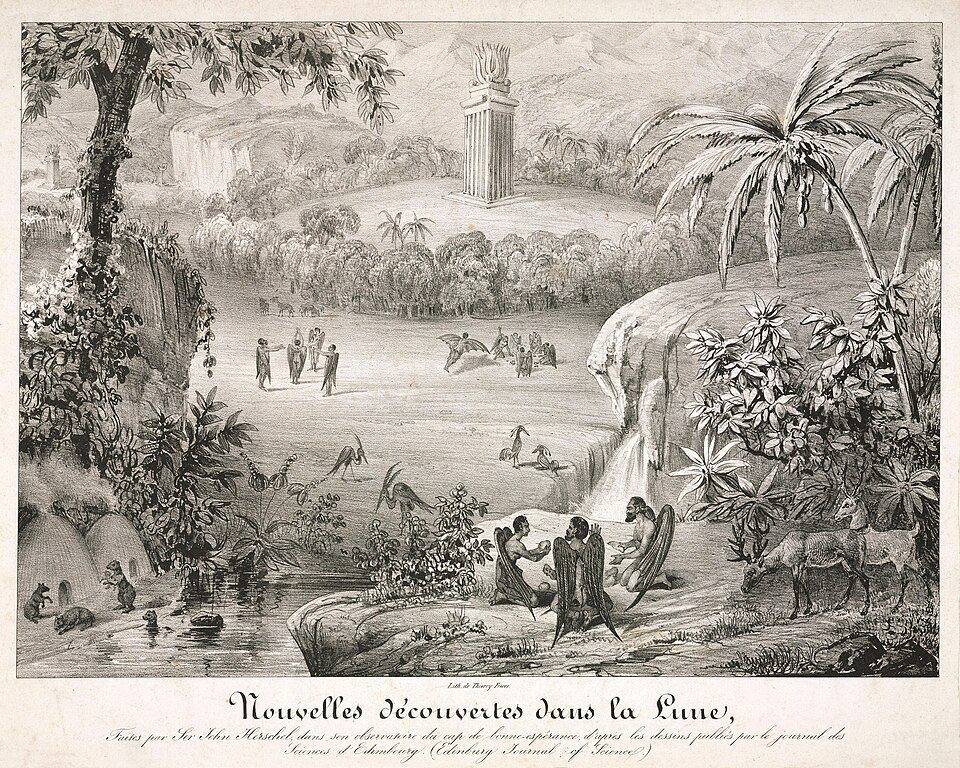
In August 1835, readers of a New York newspaper were invited to look through a telescope more powerful than any instrument the world had ever seen. On the other end was the Moon, no longer a remote disk marked by craters and shadows but a world of forests, rocks, water and creatures. There were animals resembling terrestrial species, though not always behaving like them. Then came the discovery that made the story immortal: winged, humanlike beings moving through a lunar landscape.
Nothing of the kind had been observed. The telescope described in the articles did not exist, and the astronomer whose name lent the reports their authority had made no such discovery. Yet the story was not circulated anonymously as a traveller's tale or advertised as fiction. It appeared in The Sun, a New York penny newspaper, in six instalments beginning on 25 August 1835, dressed as a report of extraordinary scientific discoveries.
The episode is generally remembered as the Great Moon Hoax. It is often retold as evidence that nineteenth-century readers would believe almost anything. That is a convenient moral, but the actual story is better. The reports were built from real science, respectable names, plausible arrangements of information, and expectations that had been cultivated for years. They were also challenged by contemporaries, including rival newspapers, before their falsity became settled history. The Moon Hoax was not simply an occasion when everyone was fooled. It was a public argument about what counted as trustworthy knowledge.
A genuine astronomer and an imaginary discovery

The supposed discoverer was Sir John Herschel, one of the most prominent astronomers of his generation and the son of William Herschel. John Herschel really was in southern Africa. In 1834 he had established an observing programme near Cape Town to survey the southern sky, extending work on stars and nebulae that could not readily be studied from northern latitudes.
That fact mattered. A report concerning an entirely invented astronomer at an imaginary observatory would have been easier to dismiss. Here the foundation was genuine, and a reader who checked the most accessible part of the claim would find that Herschel had indeed travelled to the Cape of Good Hope. The deception concerned what he was supposed to have seen there.
The articles were attributed to an otherwise fictional Dr Andrew Grant and claimed to derive from a supplement to the Edinburgh Journal of Science. The journal had once existed but had ceased publication. The authority of a real scientific title survived in the reader's imagination even after the publication itself had stopped. It was a particularly effective device in an era when news could travel faster than the documents needed to verify it.
The account began by describing a gigantic instrument, complete with elaborate optical and engineering details. Its technical language was part of the performance. Once readers had accepted that such a telescope could be built, the landscapes and creatures supposedly seen through it followed by degrees. The narrative moved from terrain and vegetation to increasingly strange forms of animal life, and ultimately to the winged lunar people later nicknamed the bat-men.
This progression is important. The tale did not begin with its most incredible claim. It invited readers to accept a mechanism, then carried that acceptance into a succession of observations. In doing so, it borrowed one of science's most persuasive habits: the explanation of how an observation had been made.
A Moon that people were prepared to inhabit

It is easy to read the lunar descriptions now and wonder how anyone could have believed them. But that reaction depends upon knowledge the readers of 1835 did not possess. Nineteenth-century astronomers could identify mountains and other surface features on the Moon, yet they had not inspected its environment with spacecraft or tested lunar materials directly. The limits of the available instruments left considerable room for conjecture.
Ideas about inhabitants of other worlds were not confined to fantasy literature. The plurality of inhabited worlds had a long intellectual history, reaching into debates in astronomy, theology and natural philosophy. Some respected writers thought it reasonable, even likely, that other celestial bodies were populated. The Scottish minister and popular science author Thomas Dick made such speculation familiar to a wide readership, weaving it into an understanding of creation that joined religion and science.
Richard Adams Locke, the Sun writer generally identified as the author, later described his articles as satire aimed partly at this style of confident speculation. That explanation has merit: the elaborate claims resemble an exaggeration of arguments already made in earnest. But an author's later account of his intention is not the same thing as proof of how every contemporary reader understood the work. Nor does satire cease to have consequences when its audience takes it literally.
The problem for Locke, if satire was indeed his principal intention, was that the supposed absurdity lay closer to accepted expectations than he may have realised. He imitated the rhetoric of popular astronomical writing well enough that the imitation was mistaken for a discovery.
How the newspaper made a world
The Sun was part of the new penny press, designed for a broader reading public than the expensive newspapers traditionally associated with merchants and political elites. Its cheap price, lively reporting and interest in unusual stories helped enlarge the newspaper audience. Sensation was not foreign to its business model.
The Moon reports benefited from that environment. Published serially, they offered a reason to buy another issue. Each instalment enlarged the world created by the previous one. The tale also acquired momentum through repetition by other papers and through conversation. A reader did not need to have examined the claimed scientific source personally to hear that Herschel had found astonishing things. The newspaper report became news about a newspaper report.
The Sun itself had an obvious commercial interest in the attention the series attracted. Circulation figures repeated in popular accounts vary and should be approached cautiously, particularly when drawn from promotional claims. The effect on public discussion is better established than any precise count of believers. The articles travelled widely, were reprinted and adapted, and gave rise to illustrations in which the inhabitants of the Moon became far more visually memorable than the supposed astronomical method that had revealed them.
A striking feature of the original narrative is how many ordinary details were doing extraordinary work. There was a recognised astronomer, a real location, a plausible reason for observing the southern heavens, a journal whose name sounded authoritative, and a carefully described instrument. The imaginary creatures arrived surrounded by facts that were either true or close enough to truth to look convincing.
That is a different explanation from claiming that readers were simply gullible. The hoax worked partly because the story resembled what informed readers had learned to expect from scientific discovery.
Not everyone believed the bat-men
The customary retelling often skips from the arrival of the articles to their widespread acceptance, as though the public had responded with one mind. Contemporary newspaper debate shows otherwise.
Rival editors had both a reason and an opportunity to inspect the claim. They questioned the supposed source, challenged the astronomical story and disputed one another's handling of it. By the end of August, while the series was still appearing, the New York Herald was publicly treating the affair as a fabrication. The objections mattered because they arose within the same information environment as the story itself. Readers in 1835 did not have to wait for twentieth-century scientific knowledge to become sceptical. Some of their contemporaries already saw reasons for doubt.
There were different kinds of doubt. A reader might find the lunar animals improbable while knowing little about telescope optics. A rival editor could ask whether the reported scientific publication existed in the stated form. A technically informed observer might object to what the instrument supposedly accomplished. Others may simply have recognised the extravagance of the prose or suspected that a spectacular claim from a competing paper deserved verification before republication.
This diversity of responses is easy to lose when the incident becomes an anecdote about credulity. Newspaper historians have examined the editorials and letters printed around the hoax as an early public dispute over journalistic ethics. It raised questions about whether a paper had a responsibility to distinguish reporting from literary invention and whether one newspaper was obliged to challenge falsehoods published by another.
It is tempting to imagine a clear moment at which the deception ended and the public returned to common sense. The record is less tidy. Later popular summaries sometimes say that The Sun confessed the hoax on 16 September. Accounts grounded more closely in the contemporary exchanges dispute that characterisation: the paper did not simply issue the unambiguous confession that a modern reader might expect. Locke's own later statements about authorship and satirical purpose also came after the first flurry of publicity.
There was therefore no single instantaneous conversion from universal belief to universal disbelief. Some readers had doubted the story early; some accepted it for a time; others may have enjoyed it without caring very much whether it was true. That uncertainty about individual responses should be preserved, rather than disguised behind a claim that an entire city had been fooled.
The trouble with a successful satire
Locke's intended target, if we accept his later explanation, was not ordinary people's interest in the heavens. It was the confident assertion that inhabited worlds must exist, offered by writers who joined speculation to the prestige of science. The Moon Hoax pushed that confidence toward absurdity by supplying the observation such writers could not actually produce.
But satire has an awkward dependence on its audience. It requires readers to recognise that something is being exaggerated or exposed. If they do not, it can strengthen the very assumptions it meant to ridicule. The more persuasive Locke made his imitation, the less plainly it appeared to be a parody.
The case also sits near the early history of science fiction. In June of that same year, Edgar Allan Poe published The Unparalleled Adventure of One Hans Pfaall, a fictional balloon voyage to the Moon, and later complained that Locke had borrowed from his story. But imagined lunar journeys had a much older history, and the resemblance between Poe and Locke was not itself evidence of plagiarism. The significant difference was that The Sun presented its lunar population not as travellers' fantasy but as a recent scientific discovery.
The distinction is not a narrow literary technicality. It changes the reader's relationship to the material. A convincing imaginary telescope in fiction is an invention to be enjoyed and perhaps examined. A convincing imaginary telescope presented as scientific news asks for belief. That request carries responsibilities, even when the writer believes the knowledgeable reader should recognise the joke.
The inhabited worlds that came before and after

Long before Locke's winged lunar people, writers had populated the heavens with other societies. In A True Story, Lucian of Samosata imagined a fantastic voyage that included a war involving inhabitants of the Moon and Sun. His tale was openly extravagant, a satire of improbable travellers' accounts. In the seventeenth century, Johannes Kepler's Somnium, published posthumously in 1634, imagined a journey to the Moon while exploring how the heavens might appear from another vantage point. Cyrano de Bergerac's The States and Empires of the Moon, published in 1657, turned lunar travel into an occasion for satire and philosophical argument. These were not claims that a telescope had revealed actual cities. They were ways of using another world to question this one.
Locke's story appeared at a moment when such imagination overlapped with serious discussion of the possibility that other celestial bodies were inhabited. That overlap mattered. Writers could invent lunar civilizations, and speculative thinkers could argue that their existence was likely; neither was the same as observing them. The Moon Hoax quietly crossed that boundary by furnishing counterfeit observations, complete with a famous astronomer and a supposed scientific journal. What older lunar voyages asked readers to imagine, the newspaper claimed had finally been seen.
Later fiction took the idea in new directions. Jules Verne's From the Earth to the Moon (1865) and Around the Moon (1870) focused on the mechanics and adventure of a human voyage, rather than the discovery of an elaborate lunar society. H. G. Wells went further in The First Men in the Moon (1901). His travellers find a civilization of insect-like Selenites beneath the surface. The underground setting was especially suggestive: as the Moon became increasingly difficult to imagine as a hospitable Earth-like world, fiction could move its inhabitants somewhere a telescope could not inspect. That was an imaginative solution, not an astronomical finding.
Mars then offered a particularly revealing comparison with the Moon Hoax. In 1877 the Italian astronomer Giovanni Schiaparelli mapped features he called canali. The Italian term did not, by itself, establish artificial waterways, but translated and interpreted as 'canals', the markings took on a technological implication. Percival Lowell subsequently championed the idea that a network of canals showed the work of intelligent Martians struggling to distribute water across a drying planet. Some astronomers challenged these observations and their interpretation. The networks were not established structures on Mars, and improved observations eventually disposed of the canal civilization.
The parallel is instructive, though the two episodes should not be equated. Locke invented his lunar observations and offered them under borrowed scientific authority. Schiaparelli made actual telescopic observations whose interpretation became contested, while Lowell developed a sincere but mistaken theory of their artificial origin. In one case, imaginary evidence was passed off as a discovery; in the other, uncertain visual evidence supported an increasingly elaborate account of a civilization no one had seen. Both demonstrated how easily a world could grow around the expectation that somebody was living there.
Fiction meanwhile made Mars a stage for more unsettling encounters. In Wells's The War of the Worlds (1898), the inhabitants of Mars come to Earth as invaders, reversing the familiar fantasy of humans visiting another world. Edgar Rice Burroughs's A Princess of Mars (first serialized in 1912) later presented a planet of rival peoples, cultures and adventures. These books did not require their readers to mistake fiction for astronomy. Yet they drew upon a broader cultural fascination with a neighbouring planet that seemed, for a time, just sufficiently known to sustain elaborate speculation.
The point is not that the Moon Hoax directly produced these later novels, or that belief in Martian canals was simply another hoax. It is that literature, scientific speculation, popular journalism and visual observation continually influenced the worlds people thought might exist beyond Earth. Sometimes the boundaries were clear. In August 1835, for a few days, they were much less so.
This ability to furnish an unknown world with felt detail has a quieter counterpart in Mara C.'s Places We Have Never Been, an essay about attachment to fictional landscapes and music. The comparison has limits: enjoying an invented town is not the same as accepting a fabricated astronomical report. A related essay, The Past We Never Lived approaches another version of this impulse through historical reconstructions that visitors knowingly enter. All three concern the images we make of worlds beyond ordinary experience, and the different kinds of trust we place in them.
What survived the discovery
The real Moon has proved stranger in some ways than Locke's imagined one, though not in the ways his articles proposed. Later astronomy and space exploration revealed a world shaped by impacts, volcanic history and the long exposure of its surface to space. We have seen it close enough to distinguish the tracks and equipment left by human visitors. None of this has made the old bat-men disappear from cultural memory.
They survive because the tale belongs as much to the history of reading and believing as to the history of astronomy. It shows how credibility can be assembled from individually plausible parts, how an imagined world can spread through a genuine communications network, and how journalism can question its own claims even as those claims become popular.
There is a further irony. The sceptical reactions, although less colourful than the lunar creatures, are among the most valuable parts of the story. They show nineteenth-century readers doing something thoroughly familiar: arguing over sources, motives, expertise, editorial responsibility and the difference between a report and a performance. The argument began while the fantastic story was still unfolding.
We do not need to congratulate ourselves for being more intelligent than the readers of 1835. We have the advantage of two centuries of additional evidence about the Moon. They had the more difficult task of judging an extraordinary claim with the knowledge and sources available to them at the time.
Some accepted it. Some doubted it. Some challenged it in print. And somewhere in the middle of that argument, for a few remarkable days, the Moon acquired forests, strange animals and a civilisation of winged people.
It was never there. The debate over whether to believe it was real.
References and editorial source notes
Locke, Richard Adams. The Moon Hoax; or, A Discovery That the Moon Has a Vast Population of Human Beings (1859 reprint of the 1835 newspaper series). See bibliographic discussion: https://www.lwcurrey.com/pages/books/168415/richard-adams-locke/the-moon-hoax-great-astronomical-discoveries-lately-made-by-sir-john-herschel-ll-d-f-r-s-c-at-the-cape
Dunlop, Doug. “The Moon Hoax of 1835: Great Astronomical Discoveries.” Smithsonian Libraries, 2013. https://blog.library.si.edu/blog/2013/08/28/great_moon_hoax_1835/
Van Riper, Kate. “The Great Moon Hoax of 1835.” Cooper Hewitt, Smithsonian Design Museum, 2015. https://www.cooperhewitt.org/2015/10/25/the-great-moon-hoax-of-1835/
Higgitt, Rebekah. “The Great Moon Hoax and the Christian Philosopher.” The Guardian, 2015. https://www.theguardian.com/science/the-h-word/2015/feb/05/great-moon-hoax-christian-philosopher-history-science
Copeland, David A. “A Series of Fortunate Events: Why People Believed Richard Adams Locke's ‘Moon Hoax.’” Journalism History 33, no. 3 (2007): 140–150. https://doi.org/10.1080/00947679.2007.12062738
Thornton, Brian. “The Moon Hoax: Debates About Ethics in 1835 New York Newspapers.” Journal of Mass Media Ethics 15, no. 2 (2000): 89–100. https://doi.org/10.1207/S15327728JMME1502_3
Zielinski, Sarah. “The Great Moon Hoax Was Simply a Sign of Its Time.” Smithsonian Magazine, 2015. https://www.smithsonianmag.com/smithsonian-institution/great-moon-hoax-was-simply-sign-its-time-180955761/
Library of Congress. “Peoples & Creatures of the Moon.” Finding Our Place in the Cosmos. https://www.loc.gov/collections/finding-our-place-in-the-cosmos-with-carl-sagan/articles-and-essays/life-on-other-worlds/peoples-and-creatures-of-the-moon/
Library of Congress. “Seeing and Interpreting Martian Oceans and Canals.” Finding Our Place in the Cosmos. https://www.loc.gov/collections/finding-our-place-in-the-cosmos-with-carl-sagan/articles-and-essays/life-on-other-worlds/seeing-and-interpreting-martian-oceans-and-canals/
Lowell Observatory. “Percival Lowell's Search for Life on Mars.” https://lowell.edu/percival-lowells-search-for-life-on-mars/
European Space Agency. “From Canals to Craters.” 2019. https://www.esa.int/Science_Exploration/Space_Science/Mars_Express/From_canals_to_craters
Library of Congress. “Belief, Legend, and the Great Moon Hoax.” 2014. https://blogs.loc.gov/folklife/2014/08/the-great-moon-hoax/
The Encyclopedia of Science Fiction. “Fantastic Voyages.” https://sf-encyclopedia.com/entry/fantastic_voyages
Poe Society of Baltimore. “Imaginary Voyages” (scholarly headnote). https://www.eapoe.org/works/pollin/brp1u008.htm

Decades later, Georges Méliès gave the imagined lunar journey one of its most memorable cinematic forms in the black-and-white silent film A Trip to the Moon (1902). Its fanciful Moon belongs to a later history of fictional lunar travel, not to the purported telescopic discoveries of 1835.
