
Rockabilly from the Crypt
Psychobilly, Horror Punk, and the Music of Monsters
Somewhere in the imaginary back room of rock and roll, the jukebox is still working. Its chrome has tarnished. The floor is sticky. A battered double bass leans against the wall, and someone has left a plastic skull beside the amplifier. The records are old, but nobody seems particularly interested in behaving as though they belong in a museum.
Then the drummer counts in. The bass begins to slap. The guitar sounds like a 1950s dance record dragged through a scrapyard. Somebody starts singing about a monster, a corpse, or a romance that has gone horribly wrong. Quite possibly all three.
Welcome to psychobilly. Or horror punk. Or one of the several unsanitary rooms that connect them.
The attraction is easy enough to hear, even if the categories are not always easy to sort out. Rock and roll has been flirting with danger since its infancy. It had sex, speed, juvenile delinquency, scandal, and parents certain that civilization was coming apart. Horror added an especially useful prop: the monster. Monsters could be frightening, ridiculous, glamorous, disgusting, or tragically misunderstood. They were also excellent company for people who had never been particularly comfortable in respectable society.
There is a temptation to treat every band with skull makeup as part of a single musical family. Resist it. The Cramps, the Meteors, and the Misfits have much in common, but they do not sound the same, and the differences are part of the pleasure. One group excavated the sordid delights of early rock and roll; another helped build a subculture around a furious upright-bass rhythm; a third turned old horror movies into punk anthems that could be shouted by an entire room.
What ties them together is not a precise guitar tone, a costume, or even an obsession with death. It is the discovery that horror makes wonderful raw material for pop music, provided you know what to do with it.
Before the corpse began dancing
Psychobilly's foundation was laid long before anyone had thought to make a coffin-shaped double bass.
In the 1950s, rockabilly brought country music into collision with rhythm and blues and the new commercial vocabulary of rock and roll. The upright bass could perform two jobs at once: a pitched line and a sharp percussive slap. Electric guitars delivered clipped figures, bends, tremolo, and echo. The music was physically economical but enormously animated. A small band could sound like a mechanical contraption that had shaken itself loose from its bolts.
And early rock and roll was already stranger than sanitized nostalgia suggests. Novelty records, exaggerated voices, ghost stories, wild-man performances, and grotesque jokes thrived alongside teenage love songs. Screamin' Jay Hawkins's theatrical excess and the feral recordings of Hasil Adkins offer reminders that the supposedly innocent old days were not universally innocent, or even especially well behaved.
The horror-film industry supplied another inheritance. Low-budget features, science-fiction invasion pictures, monster serials, drive-in advertisements, and lurid posters offered a storehouse of images that could be seized without much reverence. The improbable creature was useful precisely because it was improbable. A rubber monster could become a joke, a sexual metaphor, a threat, or a badge of solidarity for outsiders. Sometimes the same monster managed all four.
Punk later stripped away what it considered musical excess. It rewarded directness, velocity, DIY production, and a willingness to offend. The combination was obvious in hindsight: take the rhythmic skeleton of rockabilly, give it punk's impatience, and decorate it with the cheap thrills of a midnight cinema. But genres do not arrive in neat equations, and psychobilly was not born in a single studio or on one particular night.
The Cramps and the fine art of bad taste
If this music had a haunted ancestral home, the Cramps would be lurking in its basement.
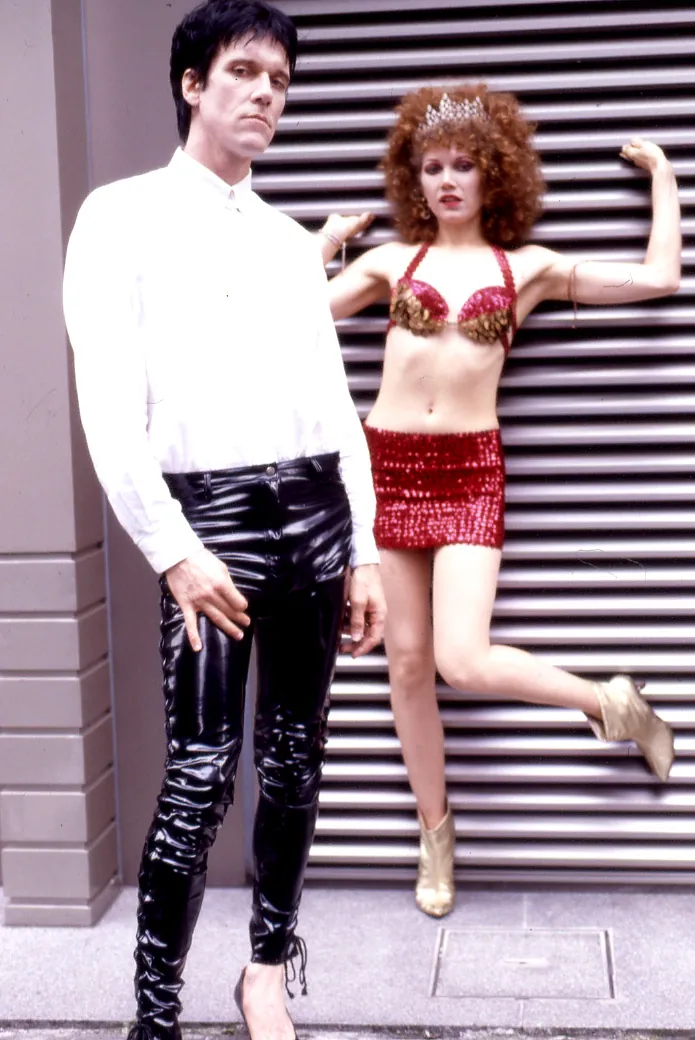
Formed in the 1970s around Lux Interior and Poison Ivy, the Cramps were meticulous collectors and spectacularly unrespectable interpreters of American popular culture. Their raw materials included rockabilly, garage rock, rhythm and blues, old records that mainstream taste had forgotten, and the sort of exploitation cinema that usually came with an outrageous poster and a dubious promise.
Their recordings sound less like a conventional rock band dressed for Halloween than like some half-buried alternative history of rock and roll. Listen to the insectile insistence of “Human Fly,” the stalking tension of “Garbageman,” or the album Songs the Lord Taught Us (1980). The guitar lines can be spare and cavernous. The rhythm can be primitive in the best sense: it knows exactly which nerve it wants to hit. Interior's voice is capable of turning a cheap monster-movie premise into an event, while Ivy's guitar playing gives the spectacle musical discipline. All that apparent disorder has structure.
The Cramps also complicate the genre's family tree. They used the word psychobilly in early promotional language, but they did not simply invent the standardized psychobilly sound later associated with fast European trios and their slap basses. In fact, their mixture of garage, blues, rockabilly, and erotic camp was more unruly than the label suggests. They are foundational partly because later musicians took their ideas in directions the Cramps themselves did not need to follow.
It matters that their work was funny. Not only funny, and never quite harmless, but often gloriously absurd. The band's investment in bad taste was too knowing to be mistaken for incompetence. What other listeners dismissed as trash, Interior and Ivy treated as a cultural archive worth raiding. Forgotten B-sides and dubious horror posters had their own aesthetic logic, and they could be put to work again.
That is more interesting than the usual tale of a band trying to shock parents. The Cramps did not merely display monsters. They made the familiar world seem like the stranger place.
The Meteors and the sound of a scene
Across the Atlantic, the music acquired a harder collective identity.
The Meteors emerged in Britain around 1980 and became central to the development of psychobilly as a recognizable sound and scene. Where the Cramps were gleefully hard to categorize, the British movement crystallized a working formula: rockabilly's galloping pulse and upright bass, punk's speed and aggression, horror-inflected lyrics, and an audience prepared to turn the resulting racket into a way of life.
The distinction is worth keeping. A group can be influential without being the sole inventor of what follows. The Meteors were not the first musicians to mix macabre humour with rockabilly, but their role in defining early British psychobilly is substantial. The scene grew in clubs and through the work of other bands, including Guana Batz and Demented Are Go, each of whom pushed the sound in a different direction. Some leaned toward cleanly articulated rockabilly structures; others preferred a dirtier, more abrasive assault.
The double bass became one of the form's unmistakable signatures. It is a wonderful instrument for this job because it is both audible and visible. The player can pluck and strike the strings to produce a rhythmic crack, while the body of the instrument seems almost to wrestle with the musician. In a loud, accelerated arrangement, the slap is not quaint period decoration. It is a second percussion section with a pulse of its own.
Then there is the audience: high hair, tattoos, creepers, customized jackets, and dances that may look alarming from the edge of the floor. Clothes and rituals can appear superficial to outsiders. But scenes survive because they create places where people recognize one another. Kimberly Kattari's ethnographic study of psychobilly is useful here. Rather than treating the music as a novelty genre or Halloween soundtrack, she examines the belonging, humour, marginality, and endurance found among its participants. The monsters are not merely decorations for an otherwise ordinary social club. They help define what sort of club it is.
You can dislike the fashions and still recognize the achievement. A supposedly ridiculous hybrid of antique dance music and cheap-horror obsessions managed to establish a durable international subculture. There are grander artistic ambitions. Not all of them last as long.
The Misfits: sing along with the dead
Horror punk approaches the crypt from a different doorway.
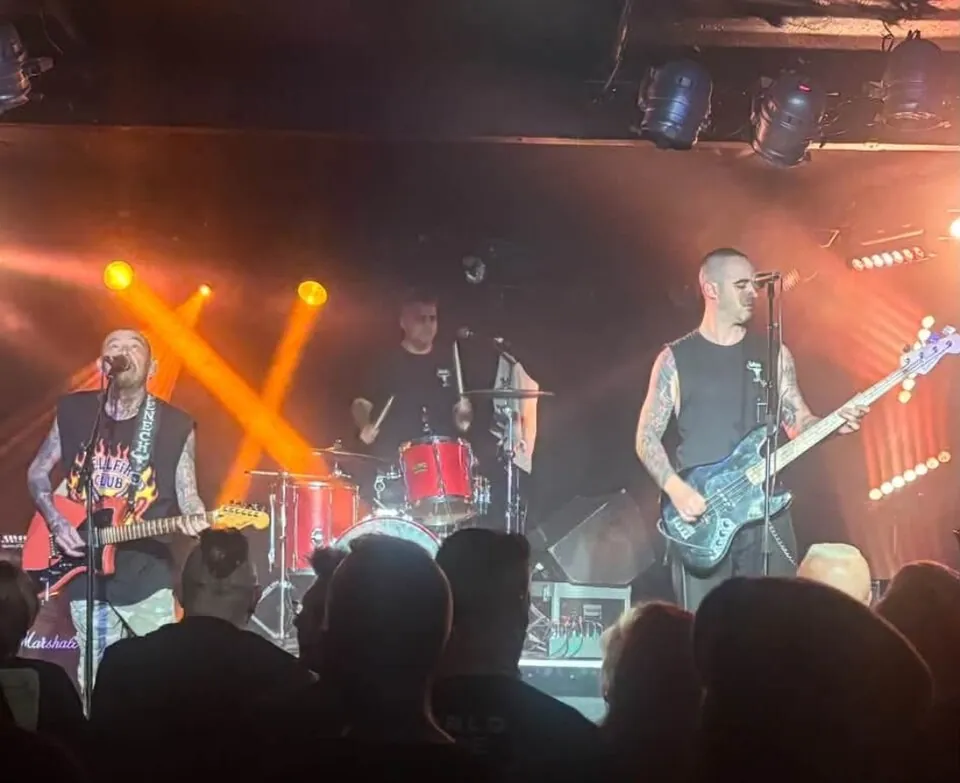
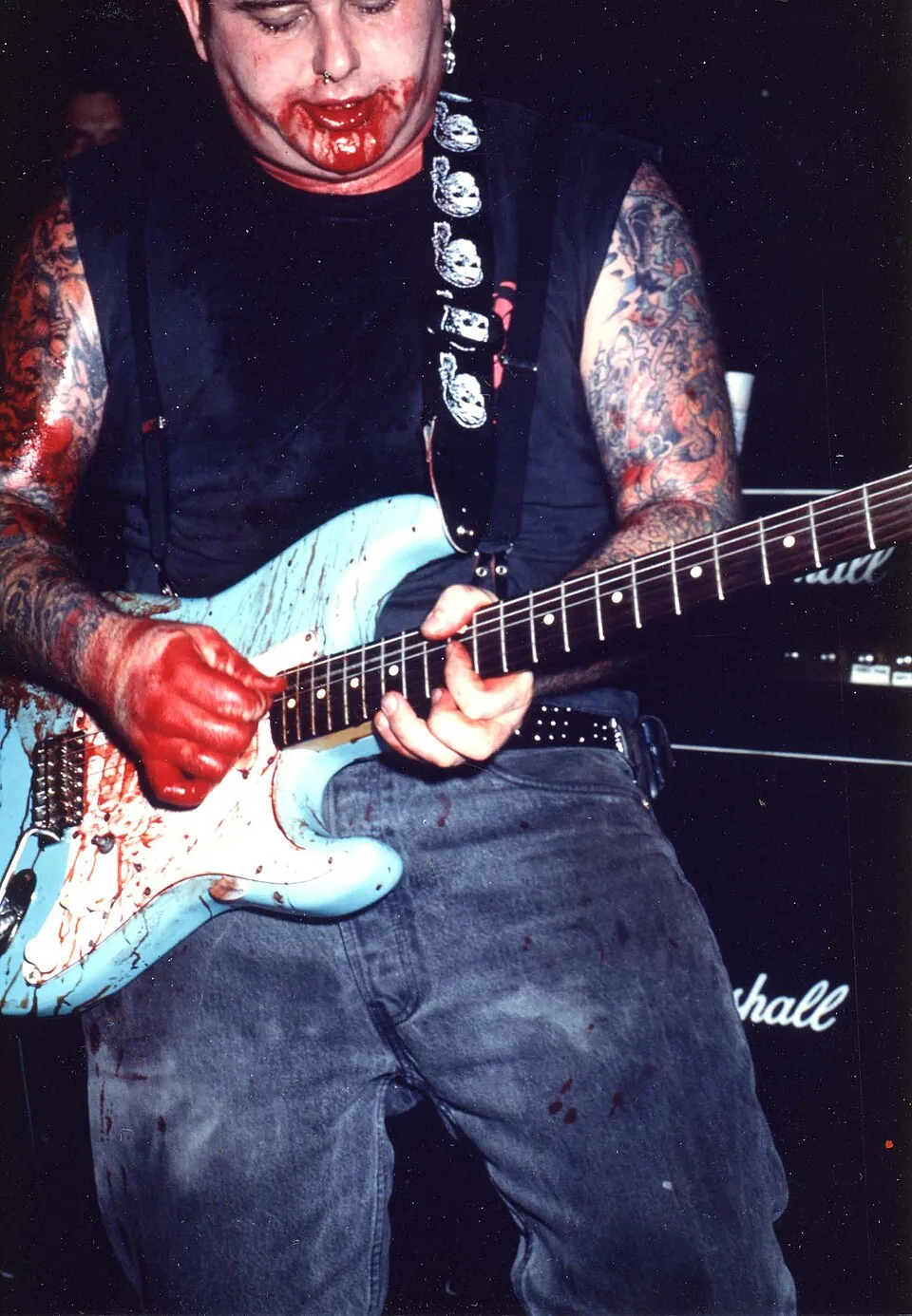
The Misfits formed in New Jersey in 1977. Their early music came out of punk, and the horror connection was fundamental to their language of presentation. Songs drew on monsters, murder, science fiction, and the imagery of old films. The famous skull emblem and the sharply recognizable devilock helped make the band's identity instantly legible, even at a distance or reproduced badly on a photocopied flyer.
But the Misfits' most important weapon may have been melody. Under the snarling surface sat remarkably direct vocal hooks, sometimes indebted to the pop instincts of older rock and roll. “Horror Business,” “Night of the Living Dead,” and “Astro Zombies” show how quickly a lurid premise can become a compact punk song. The songs are confrontational; they are also designed to stay in your head.
That is where horror punk diverges most clearly from the classic psychobilly arrangement. The Misfits generally drive forward through guitars, bass, and drums in the punk tradition rather than organizing the music around rockabilly's upright-bass slap. Their horror vocabulary works as a visual and lyrical world. Sometimes the song feels like a compressed film plot. Sometimes a title or image is enough: a couple of words establish the monster, and the audience supplies the rest.
One need not pretend the lyrics are all sophisticated literature. Nor should the violence always be dismissed as harmless just because the singer is in costume. Exploitation cinema has a history of treating bodies, particularly women's bodies, as disposable scenery, and musicians borrowing from that cinema inherit some of its problems. Camp can make a grotesque image absurd, but it does not automatically settle every question of taste or meaning.
Still, horror punk has an impressive skill: it makes death communal and strangely buoyant. The film monster that normally appears alone in a dark corridor becomes something a roomful of people can sing about together. The threat turns into a chorus. It is difficult to remain solemn while shouting along with a hundred other ghouls.
Copenhagen sends a coffin
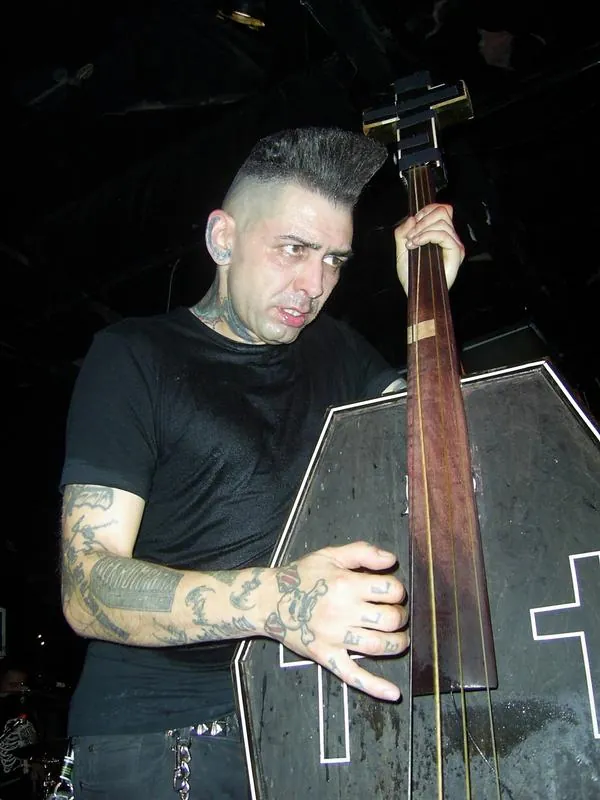
By the late 1980s, psychobilly had travelled far beyond its early British circuits. Denmark's Nekromantix, formed by Kim Nekroman in 1989, are one of its most distinctive later representatives.
Nekroman's signature coffin-shaped upright bass is almost too perfect a symbol. The instrument is real and functional, but it is also a visual gag with the force of an emblem. Death has been converted into something that generates rhythm. The group uses the old psychobilly resources of slap bass, fast guitars, and monster narratives, but presents them with a theatrical consistency that makes the music instantly identifiable. Albums such as Curse of the Coffin (1991) and Return of the Loving Dead (2002) make the joke explicit without reducing the songs to jokes alone.
The band is also a reminder that these sounds circulate across borders. The usual history of popular music travels from America to Britain and back, as though the rest of the planet were merely watching. Psychobilly's subsequent life in continental Europe, North America, and elsewhere makes nonsense of that tidy route. Once a scene develops its own conventions, musicians in different places can adopt and alter them without waiting for approval from the supposed center.
The band HorrorPops, associated with Nekroman and bassist-vocalist Patricia Day, offers another example of how rockabilly, punk, and horror aesthetics can be rearranged. There is a shared vocabulary, but no obligation to use it in exactly the same way.
From Japan, with skeletons
If the Misfits showed how easily a horror film could be turned into a punk anthem, Japan's BALZAC showed how the idea could travel and mutate.
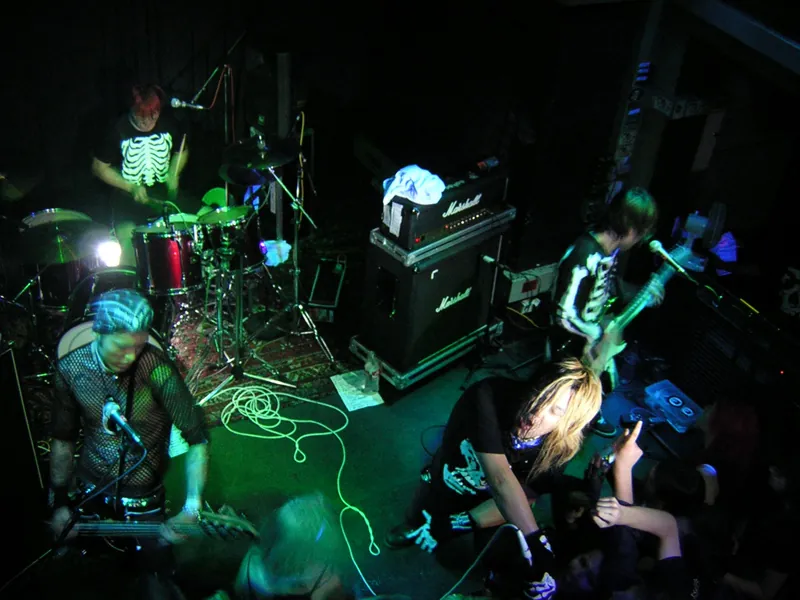
Formed in 1992 around Hirosuke Nishiyama, BALZAC drew openly on the Misfits and Glenn Danzig's Samhain. Skeleton suits and grotesque designs made the connection visible. The group's recordings, however, range beyond straightforward imitation, moving through hard punk, melody, noise, and electronic textures. Their imagery also became an elaborate world of artwork, characters, clothing, and collectibles. To dismiss all of that as merchandising would be rather unimaginative: horror has always depended on memorable props, and punk was never allergic to an effective logo.
The kinship was not imaginary. BALZAC developed a working connection with the Misfits, including shared performances and releases. Yet their work is also plainly a Japanese contribution to an international style, not merely an American original reproduced at a geographical distance. The band absorbed an inherited set of sounds and images and made its own decisions about their uses.
This is where the term horror music begins to become less useful. Japan has an abundance of musical theatre, visual invention, and performers working with demons, monsters, fantasy, and the uncanny. But visual kei is a broad field of approaches to performance and appearance, not simply a horror-rock genre. The demonic pageantry of Seikima-II, the unsettling idol-performance aesthetics of NECRONOMIDOL, and the elaborate metal/pop spectacle of BABYMETAL should not be filed under psychobilly merely because their presentations can be dark or theatrical. Their musical genealogies matter.
There is room for all of them in a discussion of musical monsters. There is no need to pretend they inhabit the same room.
Horror, but make it industrial
And then there are bands for whom the joke gives way to something colder.
White Zombie borrowed enthusiastically from exploitation movies, television, and horror cinema, layering samples and lurid imagery over a heavy, groove-oriented metal sound. Rob Zombie's later recordings and visual work made the connection between rock spectacle and horror filmmaking still more overt. The kinship with the Cramps is cultural rather than musical: a fascination with the discarded and excessive materials of popular entertainment, approached with very different amplifiers.
Skinny Puppy and Hocico occupy another neighbouring territory. Industrial and dark-electronic music can create dread through repetition, distorted voices, mechanical pressure, and sounds that seem bodily or inhuman. Hocico's harsh electronic assault has little need for a rockabilly shuffle or a B-movie singalong. Its horror is often less the creature springing from a coffin than the feeling that the machinery is already inside your skull.
Theatrical hard rock and metal take still other routes. Alice Cooper helped establish rock's vocabulary of staged shock; Ghost uses carefully constructed occult theatre and disarmingly accessible songs; Lordi places elaborate monsters directly onstage. None of these is interchangeable with the Misfits. What they share is the understanding that a concert can be a performance of danger whose terms the audience has willingly accepted.
Even farther out are musicians who use myth and ritual rather than cinema as primary resources. Heilung, Wardruna, and Dead Can Dance may summon an uncanny atmosphere, but it would be careless to lump their projects under horror simply because a listener finds an ancient-sounding chant unsettling. Taiwanese band Chthonic and Mexico's Cemican likewise draw on historically and culturally situated materials that deserve more than a generic label of darkness. Zeal & Ardor mobilizes a particularly charged collision of musical histories. These acts are better treated in their own essays, where context has room to breathe.
The distinction is more than a matter of genre policing. Camp, dread, religious imagery, folklore, and sonic aggression are not identical effects. A theatrical devil, a movie zombie, and an ancestral spirit may all appear under stage lights, but they arrive carrying very different baggage.
The monster has a good beat
Why does this stuff work?
Partly because horror and rock music have long dealt in the same volatile commodities: heightened emotion, physical arousal, taboo, costume, and the pleasure of making an audience react. A film builds anticipation, conceals information, and releases tension. Music can do similar things through a break, a sudden entrance, a distorted sound, or a rhythm that accelerates until it feels almost unstable. The techniques are not identical, but the overlap is useful.
There is also the emotional advantage of exaggeration. A song about ordinary disappointment can feel painfully close to life. A song about a lover returning from the grave gives the same emotion some distance and an excellent costume. Monsters can turn anxiety into comedy or enlarge a private discomfort until it becomes theatrical. Not every monster represents a hidden trauma, of course. Sometimes a werewolf is just a werewolf, and sometimes the band simply wanted a good excuse for a memorable chorus.
The best music in this territory knows when not to explain itself. The Cramps can sound genuinely unnerving without abandoning humour. The Meteors can be exhilarating without requiring their listeners to mistake the imagery for a manifesto. The Misfits make hideous subject matter surprisingly singable. Nekromantix can bring a coffin onstage and use it to keep the beat. BALZAC can turn a collection of skeletons and monsters into an entire musical identity.
There is a difference between being frightened by art and enjoying art that represents fright. Someone watching a horror film may feel a tight, uneasy suspense. A concert audience may instead feel the delight of confronting an obviously fictional danger together. As another essay in this collection explores, the pleasure of fear is not one simple reflex. And as The Dead Come Visiting reminds us, the dead do not carry the same meanings in every culture. In these songs, they are usually less honoured ancestors than unruly guests who have crashed the party.
A good horror song can be disgusting, silly, frightening, sexy, abrasive, or unexpectedly tender. The trick is to make those choices musical rather than merely visual. Skulls printed on a shirt will get you only so far. Eventually somebody has to play.
The jukebox is still working
Genres tend to acquire guardians who insist there was one authentic beginning and everything since has been dilution. The history here suggests something messier and more entertaining. The Cramps scavenged the odd corners of American music; the British psychobilly scene created its own fierce identity; the Misfits approached horror through punk hooks; later groups on several continents made fresh arrangements with the same imaginary creatures.
The connection was never a single sound. It was permission: permission to take despised cultural rubbish seriously, to laugh at death, to turn a low-budget monster into a shared emblem, and to make music that was as bodily and immediate as the cinema was ridiculous.
When the last song ends, the vampires and zombies go home, the makeup comes off, and somebody has to carry the double bass out to the van. The monster was an act. The music was not.
And if that old jukebox is still running, there is probably another record worth hearing.